Achy Joints? Your Cartilage Isn’t Wearing Out—It’s Starving for Movement
If your knees, hips, or shoulders ache, you’ve probably heard the “wear and tear” story.
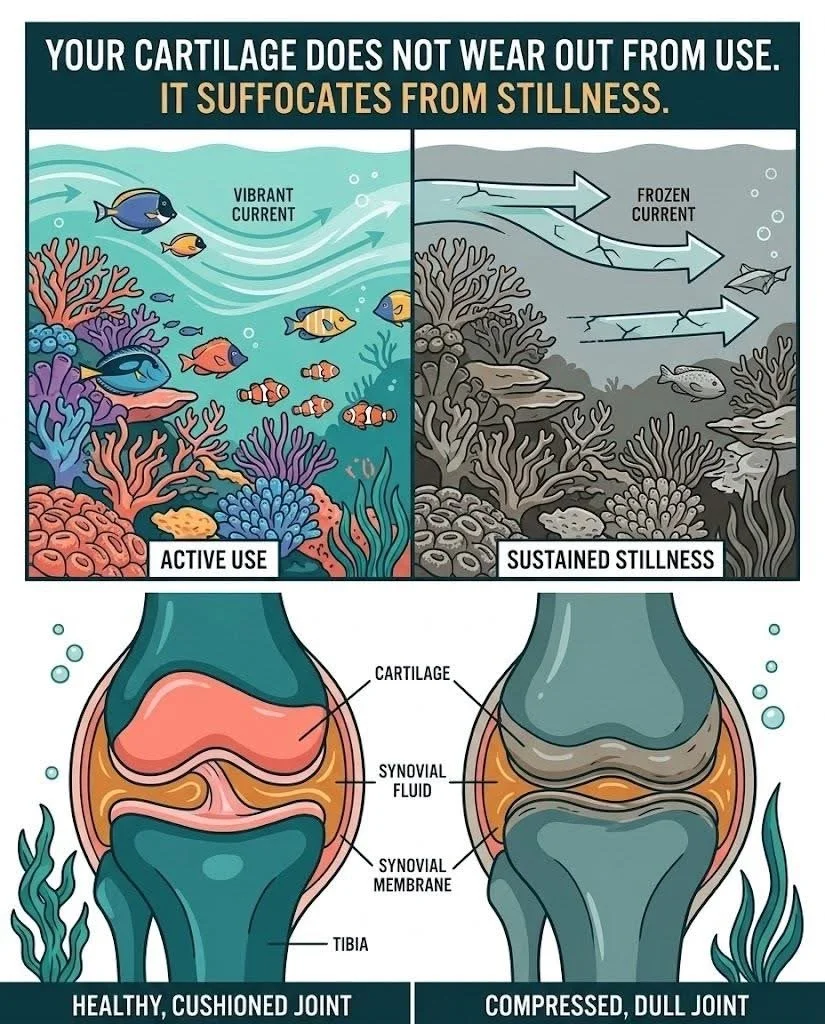
Here’s the real truth: Your cartilage doesn’t wear out from use. It suffocates from not being used.
This simple shift changes everything about how you care for achy joints—especially if you have ADHD and need info that’s quick, clear, and actionable.
Cartilage 101: No Blood Supply = Needs Movement to Eat
Cartilage is the smooth, slippery cushion inside your joints.
Key fact: It has zero blood vessels. No direct blood supply means it can’t get nutrients the normal way.
Instead, it relies on synovial fluid (the joint’s “oil”) for oxygen, glucose, and everything else it needs. Nutrients soak in through diffusion—like a sponge absorbing water.
But here’s the catch:
• Without movement, the fluid sits still.
• Compression + release (from walking, bending, or gentle loading) pumps fresh nutrients in and flushes waste out.
Science backs this: Studies show cyclic loading (normal everyday movement) boosts nutrient delivery, especially for bigger molecules your cartilage needs to stay healthy.
Bottom line: Cartilage stays alive and plump because of motion—not despite it.
The Coral Reef Analogy (Super Easy to Picture)
Imagine a coral reef.
It doesn’t die because there’s not enough water.
It dies because the water stops moving.
Stagnant water = no fresh nutrients or oxygen, waste builds up, coral starves and turns white.
Your joints work exactly the same way.
• Cartilage = coral
• Synovial fluid = ocean water
• Movement = waves and current
Stop moving (resting too much, sitting all day, or babying sore joints), and the “current” dies. Cartilage suffocates, gets inflamed, and breaks down.
Animal studies prove it: Cut off movement for just a few days and joints show rapid inflammation and cartilage damage. Add motion back? Things improve fast.
Why “Just Rest It” Is the Wrong Advice
Rest feels good short-term (less pain right now).
But long-term? It’s the opposite of what your joints need.
Prolonged rest:
• Slows nutrient flow
• Weakens surrounding muscles (less support for joints)
• Speeds up the very degeneration you’re trying to avoid
Over 100 clinical trials show exercise beats rest for osteoarthritis pain and function. Pain relief matches anti-inflammatory meds—but without side effects.
The Real Fix: Strategic Movements (Not Random Exercise)
The solution isn’t “push through pain” or “do nothing.”
It’s smart, consistent movement that keeps the fluid flowing without overload.
Quick-win ideas (start small—ADHD-friendly!):
• Gentle daily loading: Walk, cycle, or swim 20–30 minutes. Even short bursts help.
• Aquatic exercise or yoga/tai chi: Top-rated for pain relief and stiffness.
• Resistance bands or light weights: Build muscle support around joints.
• Move every hour: If you sit a lot, stand, shift weight, or do 10 knee bends.
Pair it with anti-inflammatory eating (lots of plants, fatty fish, nuts) for even better results.
Pro tip: Start with what feels good today. Progress slowly. Many people feel less pain in weeks—not months.
Takeaway for Your Joints
Your cartilage isn’t broken or worn out.
It’s just waiting for the “current” to start moving again.
Movement nourishes. Rest starves.
If your joints ache, don’t default to rest. Choose strategic, joint-friendly movement instead. Your body (and brain!) will thank you.
Ready to feel better? Start with one 10-minute walk today and notice how your joints respond. You’ve got this!
(Always check with your doctor or physical therapist before big changes—especially with existing conditions.)